
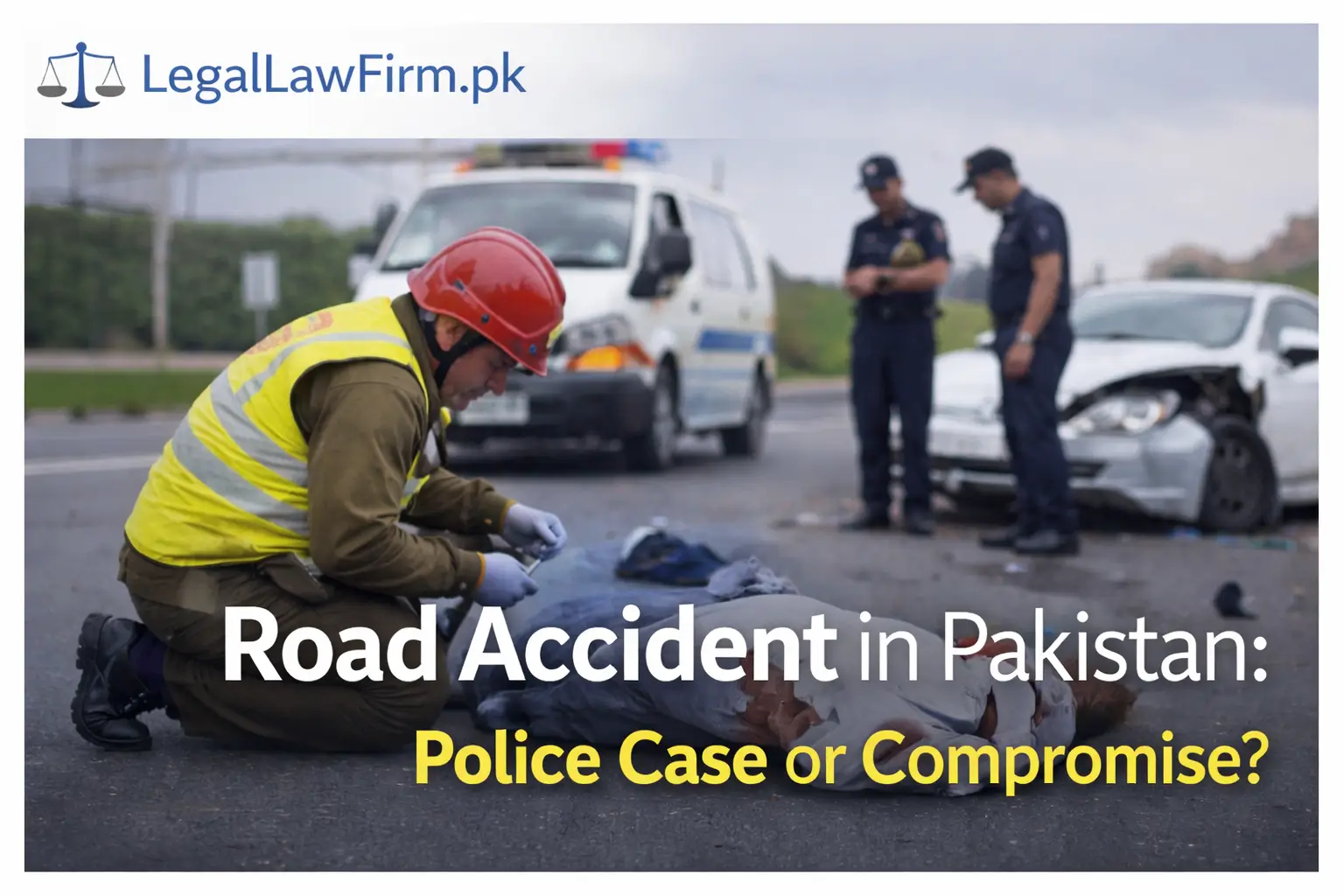
Road accidents happen every day in Pakistan. For many ordinary drivers, the big question is:
“Should we go for an FIR and full police case, or try to settle the matter by compromise?”
This guide explains, in simple language, what the law expects, when compromise is possible, and what steps you should take immediately after an accident.
Again, this is general information, not specific legal advice.
What Happens Legally After a Road Accident?
When an accident occurs with injury or death:
- The incident can become a criminal case under the Pakistan Penal Code (PPC) – usually sections related to rash and negligent driving and, in severe cases, causing death.
- Police may register a First Information Report (FIR).
- Doctors prepare a medico-legal report for injured persons.
- Insurance and compensation issues also arise.
Because of these layers, deciding about compromise is not only a moral question; it is also a legal one.
Immediate Steps You Should Take After an Accident
1. Ensure Safety First
- Move to a safe place if possible.
- Call ambulance services and take injured persons to the nearest hospital.
- Do not argue on the road while people are bleeding or in danger.
2. Call the Police (15) Early
Even if both parties think the damage is “minor”, calling the police is usually safer. A simple report keeps the record straight and can protect you later if the story changes.
3. Collect Basic Evidence
- Photos/videos of the scene, vehicles, and number plates
- Names and numbers of witnesses
- Time, location and road conditions
This basic evidence can help determine whether the case goes to court or is later compromised.
What Is a “Compromise” in Accident Cases?
In criminal law, a compromise means:
- The victim or legal heirs agree to forgive the accused, often in return for compensation, and
- The court formally accepts this compromise under the Code of Criminal Procedure.
In recent high-profile cases, courts have accepted compromises in traffic accidents where there was no intention to kill, only negligence.
However, compromise is not automatic. The court looks at:
- Nature of the offence
- Conduct of the accused
- Whether the agreement is voluntary and genuine
When Is Compromise Usually Possible?
In practice, compromise is more common when:
- The accident clearly appears to be negligent, not intentional.
- The accused helps the victims immediately (taking them to the hospital, informing families).
- The accused offers reasonable compensation after discussion.
- There is no other serious criminal history.
Even then, a judge has to approve it. Lawyers for both sides usually draft the compromise deed and present it in court.
When Compromise May Not Be Appropriate or Allowed
Compromise may be difficult or inappropriate when:
- There is evidence of drunk driving, racing or extreme recklessness.
- The accused ran away from the scene and was caught later.
- Public interest is intensely involved (for example, repeated offences, grave misconduct).
In such situations, the state may resist compromise, even if some family members are willing.
Practical Guidance for Ordinary Drivers
If You Are the Driver
- Stay at the scene if it is safe.
- Help injured persons reach the hospital.
- Cooperate with the police, give your CNIC and licence details.
- Contact your insurance company quickly.
- Avoid giving “roadside statements” about who will pay what. Wait until facts are clear.
If You Are the Victim or Family
- Make sure an MLC (medico-legal certificate) is prepared at the hospital.
If police do not register an FIR, speak to a lawyer about legal options. - Do not sign any blank papers or unclear agreements.
Police Case vs Compromise – How to Decide?
There is no single answer, but consider:
- Seriousness of injury/loss of life
- Behaviour of the other party – helpful or trying to run away?
- Strength of evidence – CCTV, witnesses, apparent negligence
- Future needs – long-term medical expenses, loss of earnings, etc.
Often, the safest route is:
- Let the police case start, and the FIR be registered.
- After medical reports and facts are on record, discuss a compromise through lawyers if both sides genuinely agree.
This protects your legal rights while still allowing a humane settlement.
How a Lawyer Can Help
A traffic or criminal defence lawyer can:
- Explain likely sections and punishments.
- Guide on bail, court appearances and insurance claims
- Draft a compromise deed if both sides agree.
- Present the settlement before the court for approval.
On this page, add internal links to:
- [[Criminal Defence service page – Road Traffic Offences section]]
- [[Our Lawyers]] – to highlight the team handling the accident and criminal cases
- [[Contact Us]] – to request legal advice
FAQs on Road Accidents and Compromise in Pakistan
Q1. Can we settle at the spot without involving the police?
People often do this, but it is risky. If the other party later files a case, you may have no record of what actually happened.
Q2. If the victim forgives us, will the court always accept a compromise?
Not always. The court still examines the facts and has discretion to accept or reject the compromise.
Q3. Does an FIR mean I will definitely be convicted?
No. FIR is only the starting point. Evidence, defence, and sometimes compromise all affect the final result.Q4. Who should pay for medical expenses in a compromise?
Usually, the accused pays a fair amount as part of the settlement. The exact figure is negotiated and then recorded in the compromise deed.


